
Yes, ICB Qualifications are recognised by employers. Here are some of the reasons why ICB Qualifications are recognised by employers:
- ICB Qualifications are accredited by the QCTO (Quality Council of Trades and Occupations)
- ICB Qualifications are scarce skill qualifications
- These qualifications are in demand
- You stand a chance to earn a decent living
- You become employable
- There are always employment opportunities available
Are ICB Courses Accredited?
Yes, ICB Courses are accredited by the following professional bodies:
- ICB (Institution of Certified Bookkeepers)
- QCTO (Quality Council of Trades Occupations)
Is ICB SAQA Accredited?
Yes, ICB is SAQA Accredited. This is because all the ICB Courses have SAQA ID numbers. Here is the list of all the ICB Courses that we offer with their SAQA ID numbers:
- Small Business Financial Management: ICB National Certificate (SAQA ID: 48736)
- Office Administration – Business Management: ICB Higher Certificate (SAQA ID: 23619)
- Financial Accounting – Business Management: ICB National Diploma (SAQA ID: 20366)
- Bookkeeping: ICB National Certificate (SAQA ID: 58375)
- Bookkeeping: ICB FET Certificate (SAQA ID: 58376)
- Technical Financial Accounting: ICB National Diploma (SAQA ID: 36213)
- Certified Financial Accounting: ICB National Diploma (SAQA ID: 20366)
- Office Administration: ICB National Certificate (SAQA ID: 23618)
- Office Administration: ICB Higher Certificate (SAQA ID: 23619)
- Office Administration: ICB National Diploma (SAQA ID: 35958)
You can go to SAQA’s Qualification Search and enter any of the above-mentioned SAQA ID numbers. If the number does not appear, then the qualification is not SAQA accredited.
Our Accreditation
Here is all the information regarding our accreditation for all of our ICB Courses.
ICB
ICB stands for the Institute of Certified Bookkeepers. All of our courses are accredited by ICB. The Institute of Certified Bookkeepers is not a college, it is an Independent External Examinations Body. They keep up with high-quality education and standards.
QCTO
QCTO stands for the Quality Council for Trades and Occupations. This is one of the three Quality Councils in South Africa. This Quality Council focuses on trades and occupations that make students work-ready.
SAQA
SAQA stands for South African Qualifications Authority. This professional body oversees the NQF system and ensures that all the courses meet the correct standards.
Is ICB Recognised In The UK?
Yes, ICB is Recognised in the UK. Here are the accrediting bodies:
- ACCA (Association of Chartered Certified Accountants)
- CIMA (Chartered Institute of Management Accountants)
- IAB (International Association of Bookkeepers)
- IAAP (International Association of Accounting Professionals)
Is ICB Recognised In South Africa?
Yes, ICB is recognised in South Africa. All of ICB’s Courses are recognised on the NQF system, and SAQA also recognises these courses. These qualifications are also in demand, which means that students who complete these courses will:
- Easily find employment
- Earn a good salary
- Go into a diverse field of study which allows them to gain entry into many positions
What Is An ICB Qualification?
An ICB Qualification is the award issued after you have completed an ICB Course or ICB Programme. Here is a list of the ICB Qualifications that you can get:
- ICB National Certificate
- ICB Further Education and Training Certificate
- ICB Higher Certificate
- ICB National Diploma
What Can I Do With An ICB Qualification?
There are many things that you can do with your ICB Qualification. Here are some of the many things that you can do:
- Find entry-level employment
- Learnership
- Internship
- Find permanent employment
- Further your studies with the next ICB Course
What Should I Study After ICB?
Here is what you can study after ICB:
- Another ICB Course
- Another ICB Programme
Here is how you can go from one ICB Programme to another:
| ICB Office Administration | ⇨ | ICB Business Management |
To go from ICB Office Administration to ICB Business Management, you will need to complete the following subjects:
| ||
- Study a Degree Course if you meet the following criteria:
- Have a Bachelor’s Matric Pass Level
- Have the relevant APS Score
- Choose the right subjects in High School
How Much Do Bookkeepers Make In The UK?
Here is how much a Bookkeeper earns in the UK:
R42 506 per year
The average salary for a bookkeeper is R 42, 506 per year in the UK.
Benefits Of Studying At Matric College
Here are some of the many benefits of studying at Matric College:
- You can register when you are financially and mentally prepared. We have no deadlines for admission to our college.
- Study at your own pace. You can go through the textbooks that we send to you and then decided whether you would like to write the final exam.
- We follow COVID-19 protocols. We are a distance learning college, which means that students do not have to attend any classes. This means that will not be in contact with other students or lecturers.
- We send you the study material. ICB does not provide the textbooks themselves. We will send you the relevant textbooks through courier service.
- You can work and study. This allows you to earn a living while you are studying. It also means that you do not have to choose between your studies and your work.
- Speak to a Course Expert. We have Course Experts that you can speak to with any course that you are interested in completing. This allows you to make an informed decision.
Who Is The ICB?
The ICB (Institute of Certified Bookkeepers) is an Independent External Examinations Body that offers business-related courses. They do not offer study material or support, but they do offer their courses through accredited training providers. These training providers have to be accredited by the DHET or ICB.
Can I Study Directly Through ICB?
No, you cannot study directly through ICB. You have to apply at an accredited training provider such as Matric College. We offer:
- Support
- Textbooks and study guides
When Was ICB Established?
ICB was established in 1931. This means that they have been in existence for over 70 decades.
What Is An ICB Level?
An ICB level is determined by the type of ICB Qualification that is achieved. Here is a list of ICB’s Qualifications with each NQF Level:
| ICB Qualification | NQF Level |
| Small Business Financial Management: ICB National Certificate | NQF Level 4 |
| Office Administration – Business Management: ICB Higher Certificate | NQF Level 5 |
| Financial Accounting – Business Management: ICB National Diploma | NQF Level 5 |
| Bookkeeping: ICB National Certificate | NQF Level 3 |
| Bookkeeping: ICB FET Certificate | NQF Level 4 |
| Technical Financial Accounting: ICB National Diploma | NQF Level 5 |
| Certified Financial Accounting: ICB National Diploma | NQF Level 6 |
| Office Administration: ICB National Certificate | NQF Level 5 |
| Office Administration: ICB Higher Certificate | NQF Level 5 |
| Office Administration: ICB National Diploma | NQF Level 6 |
How Will I Be Assessed?
PoE
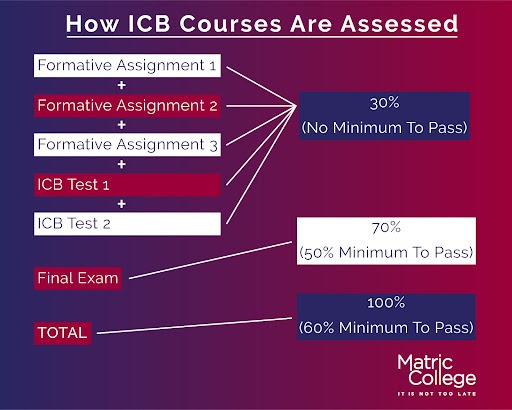
The Portfolio of Evidence is given to ICB students once they are prepared for the exams. This means that you will get a set time to complete the PoE before submitting it. This time ranges from 24 to 48 hours. During this time, you will complete:
- (3) three Assignments
- and (2) two open-book tests
The PoE has three stages. Here is what will happen in each stage:
| Stage | What will happen |
| Stage 1 | Complete assignment 1 and then complete the open book test 1 |
| Stage 2 | Complete assignment 2 and then complete the open book test 2 |
| Stage 3 | Complete assignment 3 and then complete the final exam |
Final Exam
After completing and passing the PoE with at least 50% you will qualify for the final exam. You have to pass the exam with an average of 50%, but your final mark should be at least 60%. This means that if your average score for the PoE is 50% then you should aim for 60% or more for the exams to get an average of 60% for your final mark.
Each subject has a PoE, which means if you have three (3) subjects, you will get (3) PoE. For example, if you complete the Small Business Financial Management: ICB National Certificate course, this is what you will complete:
| Subjects | PoE |
| Business Management 1 | 3 x Assignments 2 x open book tests 1 x Final Exam |
| Bookkeeping to Trial Balance | 3 x Assignments 2 x open book tests 1 x Final Exam |
| Business Literacy | 3 x Assignments 2 x open book tests 1 x Final Exam |
What Does ICB Mean?
ICB means Institute of Certified Bookkeepers. ICB offers over 10 courses that students can choose from. These courses mainly focus on:
Is The ICB Closing?
No, ICB is not closing. ICB only closes during December holidays. This means that students cannot register for any exams.
Does Unisa Recognise An ICB Qualification?
No, Unisa does not recognise ICB Qualifications. However, ICB does recognise work experience as well as other ICB subjects or qualifications that students have completed.
Get a qualification, that is:
- Accredited
- Recognised
- In demand
- Allows you to work abroad
- Gain skills that make you ready for the workplace
- Allows you to earn a great salary
- Allows you to be highly employable
Study any of our ICB Courses today and gain all the above-mentioned benefits.
Author: Jesmé Africa
Editor: Amy Venter
Date Published: May 26, 2022