
ICB Courses

ICB Courses are business courses that are designed and examined by the Institute of Certified Bookkeepers. The courses are offered by ICB Accredited Colleges either by contact learning or by distance learning.

ICB courses are career-focused business qualifications designed for people who enjoy structure, numbers, and clear career paths. Offered by the Institute of Certified Bookkeepers, these courses cover bookkeeping, accounting, business management, and office administration.They are industry-recognised and built around practical skills and real workplace application. At Matric College, these courses are available through distance learning, so you can study at your own pace from anywhere in South Africa. Here’s a full list of ICB courses available at Matric College.

Our ICB Courses

ICB Business Management Programme:

ICB Small Business Management

Small Business Financial Management: ICB National Certificate
The ICB Small Business Financial Management National Certificate course teaches students how to manage finances, run day-to-day operations, and start their own small business successfully.
Read More →
ICB Business Management

Office Administration – Business Management: ICB Higher Certificate
Gain practical skills in office management, HR, legal practices, and finance with the ICB Higher Certificate in Office Administration – Business Management. Study at your ...
Read More →
Financial Accounting - Business Management: ICB National Diploma
Financial Accounting – Business Management: ICB National Diploma

The Financial Accounting – Business Management: ICB National Diploma is the third and final course in the ICB Business Management Programme. You have to complete ...
Read More →

ICB Office Administration Programme:

ICB Office Admin National certificate

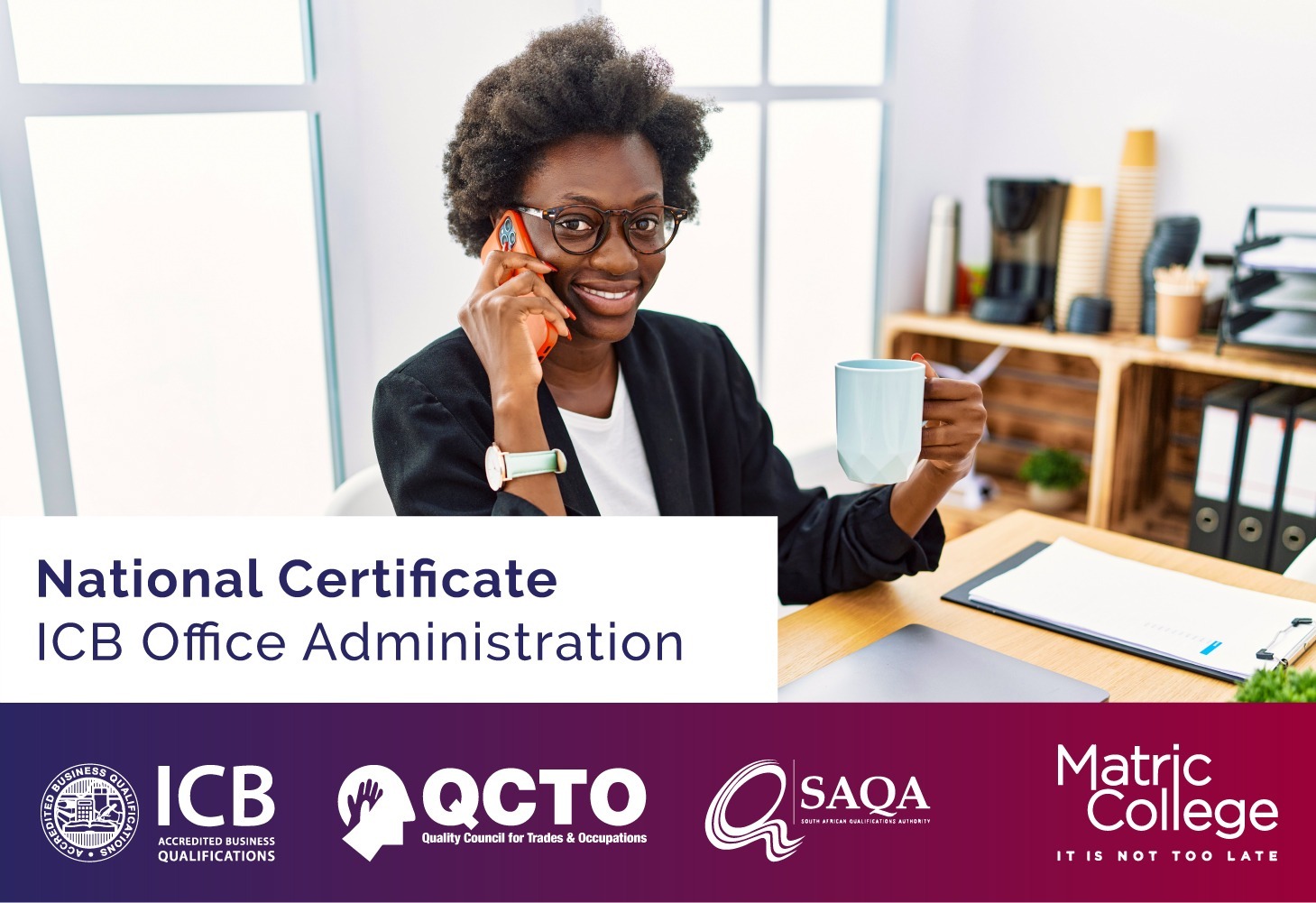
Office Administration: ICB National Certificate
The ICB Office Administration National Certificate provides you with a foundation in office administration, covering key skills in communication, bookkeeping, and business practices.
Read More →
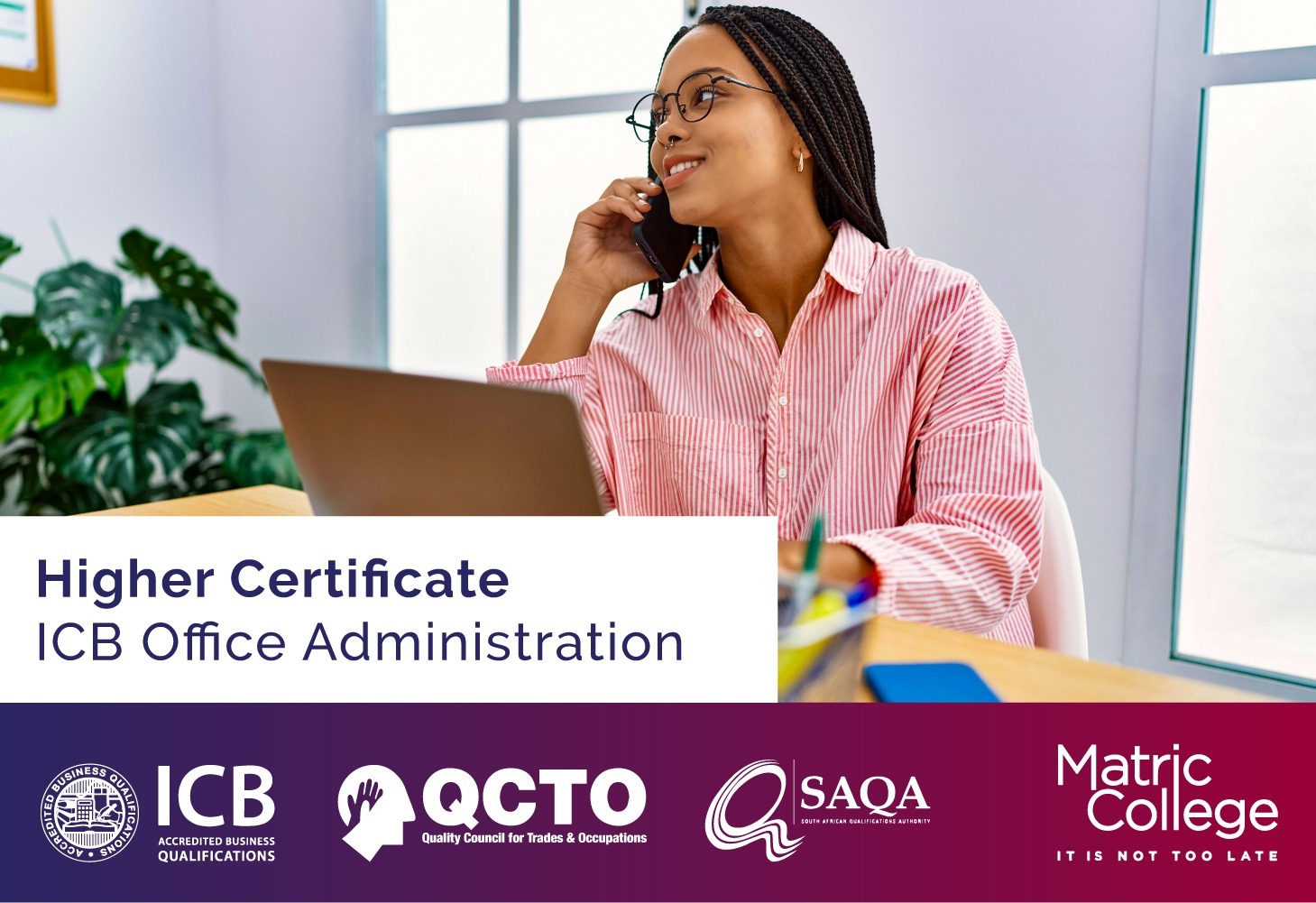
Woman multitasking on a phone call while working on a laptop—studying for her Higher Certificate in Office Administration.

Office Administration: ICB Higher Certificate
Level one done! Move forward with the Office Administration: ICB Higher Certificate and open doors to new office admin opportunities.
Read More →
ICB Office Administration National Diploma

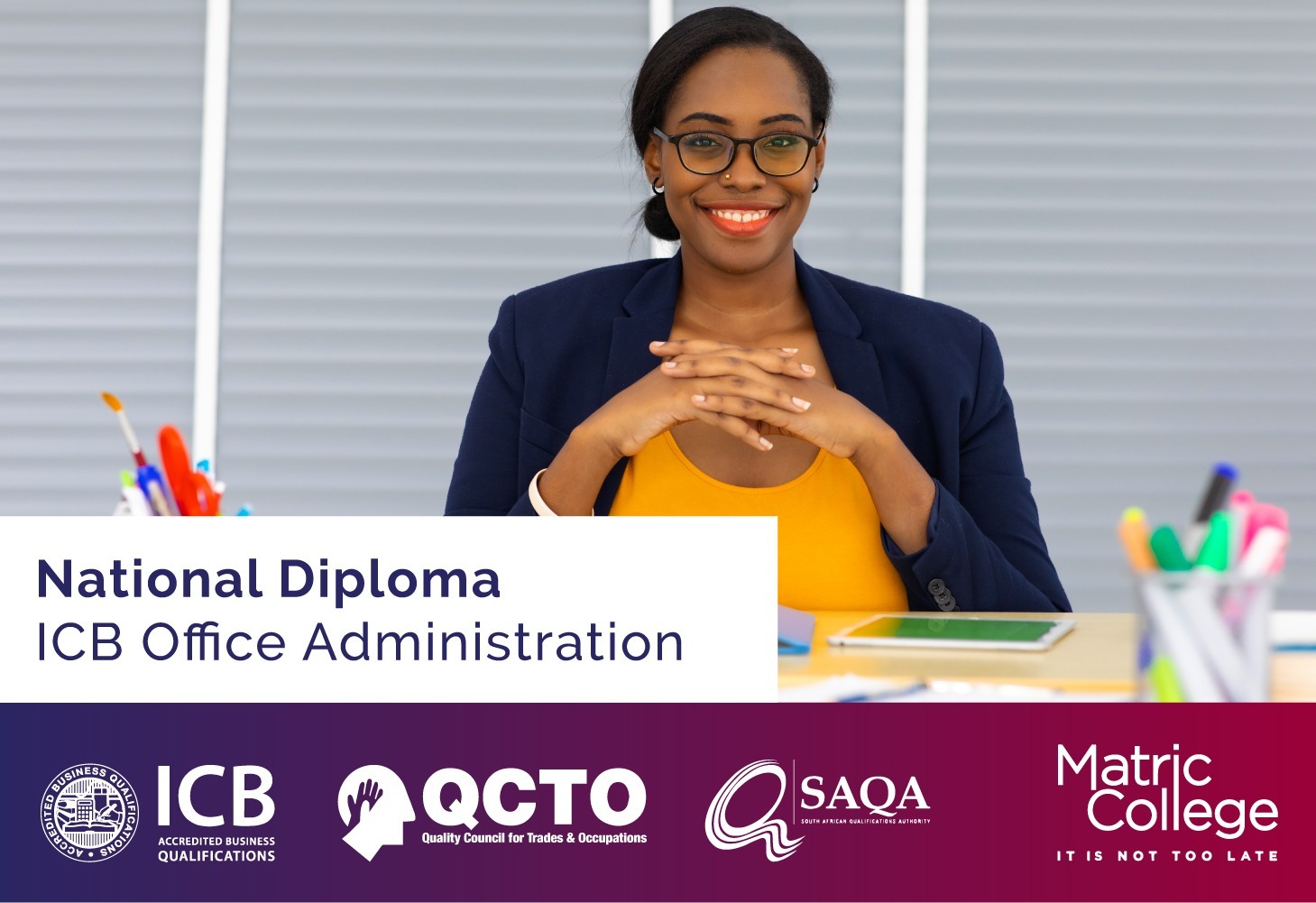
Office Administration: ICB National Diploma
The ICB Office Administration National Diploma is the final FASSET-accredited qualification, combining a series of ICB courses to equip you with essential administrative skills for ...
Read More →

ICB Financial Accounting Programme:

ICB Senior Bookkeeping FET Certificate

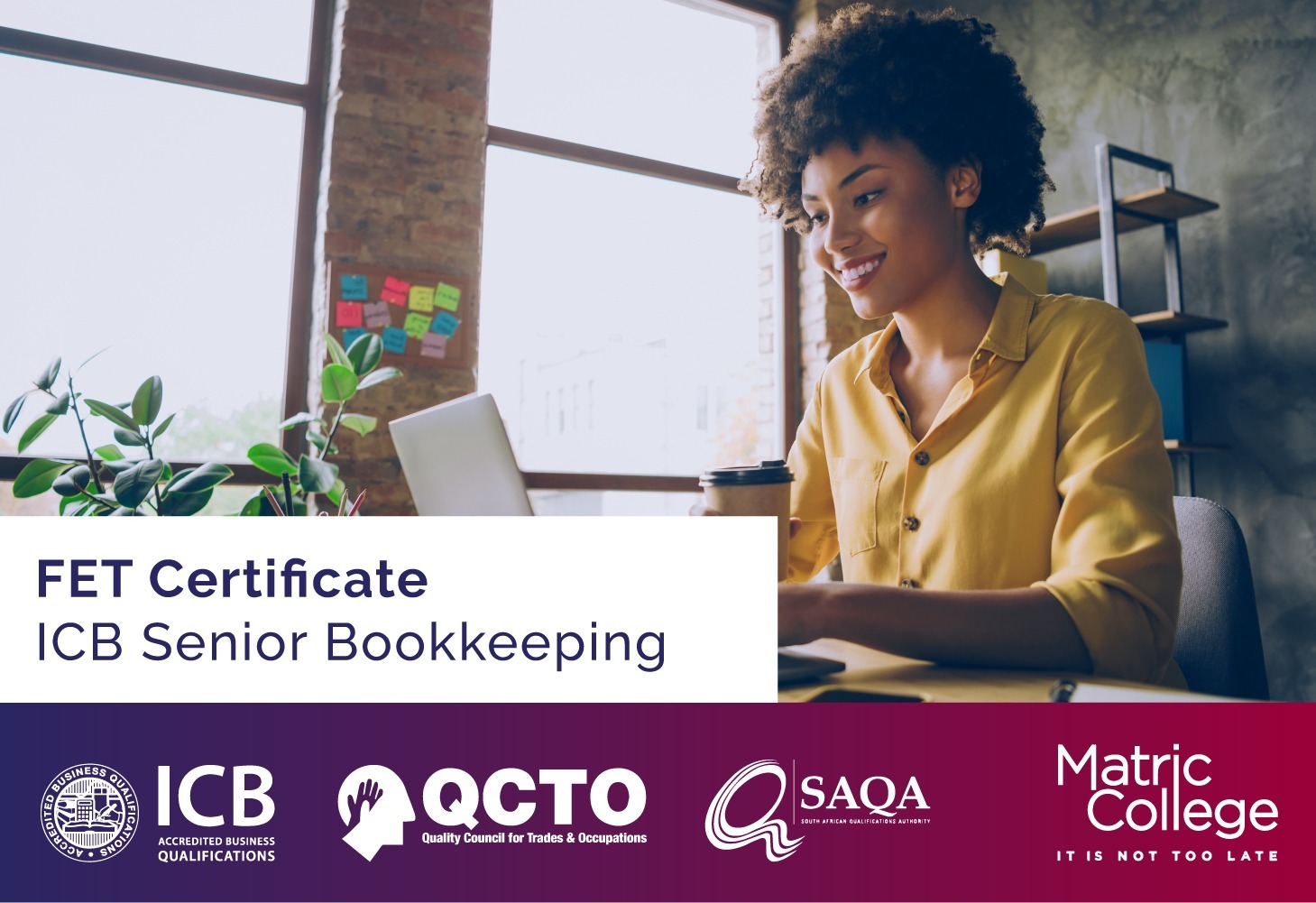
Bookkeeping: ICB FET Certificate

The ICB Bookkeeping FET Certificate builds on the National Certificate, teaching financial statements, cost management, and budgeting while preparing you for careers as a bookkeeper ...
Read More →
ICB Junior Bookkeeping National Certificate

Bookkeeping: ICB National Certificate
Earn your ICB Junior Bookkeeping Certificate online. Achieve a nationally recognised qualification and gain practical finance skills.
Read More →
ICB Certified Financial Accounting

Certified Financial Accounting: ICB National Diploma
Advance your career with the ICB Certified Financial Accounting Diploma. Remember, it is a scarce skill, and scarce skills are in demand.
Read More →
ICB Technical Financial Accounting

Technical Financial Accounting: ICB National Diploma

Learn bookkeeping, taxation, and financial reporting with the ICB Technical Financial Accounting Diploma. Prepare for careers in accounting and finance.
Read More →

What Are ICB Courses?

ICB Courses are business courses that are designed and examined by the Institute of Certified Bookkeepers. The courses are offered by ICB Accredited Colleges either by contact learning or by distance learning.

Matric College is accredited by ICB to offer ICB courses via distance learning. This means that you can study an ICB course from the comfort of your space and at your own pace. Matric College offers 3 ICB Programmes namely:

ICB Courses provide you with scarce skills. These courses are focused on specialised learning that are in great demand.

Watch Our College Principal Introduce The ICB Qualifications Offered At Matric College

ICB Business Management Courses

Small Business Financial Management: ICB National Certificate

SAQA ID: 48736
Course Credits: 120
NQF Level: Level 4
Qualification Title: Small Business Financial Management: ICB National Certificate
Qualification Type: ICB National Certificate
Course Duration: 12 Months

Entry Requirements 

  • Grade 11 (NQF 3)
  • Grade 11 Equivalent Certificate
  • ICB Junior Bookkeeping: National Certificate

Course Subjects

  • Business Management 1
  • Bookkeeping To Trial Balance
  • Business Literacy

Office Administration - Business Management: ICB Higher Certificate

SAQA ID: 23619
Course Credits: 240
NQF Level: Level 5
Qualification Title: Office Administration – Business Management: ICB Higher Certificate
Qualification Type: ICB Higher Certificate
Course Duration: 12 Months

Entry Requirements 

  • Small Business Financial Management: ICB National Certificate (Must include the Business Management 1 subject)

Course Subjects

  • Office and Legal Practice 
  • Business Management 2 
  • Marketing Management and Public Relations 
  • Financial Statements 
  • Human Resources Management and Labour Relations

Financial Accounting - Business Management: ICB National Diploma

SAQA ID: 20366
Course Credits: 280
NQF Level: Level 6
Qualification Title: Financial Accounting – Business Management: ICB National Diploma
Qualification Type: ICB National Diploma
Course Duration: 36 Months

Entry Requirements 

  • Office Administration: ICB Higher Certificate (Must include the Business Management 2 subject)

Course Subjects

  • Business Management 3
  • Financial Management and Control
  • Financial Reporting and Regulatory Frameworks
  • Research Theory and Practice

ICB Office Administration Courses

Office Administration: ICB National Certificate

SAQA ID: 23618
Course Credits: 120
NQF Level: Level 5
Qualification Title: Office Administration: ICB National Certificate
Qualification Type: ICB National Certificate
Course Duration: 24 Months

Entry Requirements 

  • Grade 12 or Equivalent

Course Subjects

  • Bookkeeping and Office Administration 1
  • Bookkeeping to Trial Balance
  • Business Law and Administrative Practice
  • Business Literacy
  • Cost and Management Accounting
  • Marketing Management and Public Relations

Office Administration: ICB Higher Certificate

SAQA ID: 23619
Course Credits: 240
NQF Level: Level 5
Qualification Title: Office Administration: ICB Higher Certificate
Qualification Type: ICB Higher Certificate
Course Duration: 28 Months

Entry Requirements

  • Office Administration: ICB National Certificate

Course Subjects

  • Business and Office Administration
  • Human Resources Management and Labour Relations 
  • Economics  

Office Administration: ICB National Diploma

SAQA ID: 35958
Course Credits: 360
NQF Level: Level 6
Qualification Title: Office Administration: ICB National Diploma
Qualification Type: ICB National Diploma
Course Duration: 36 Months 

Entry Requirements 

  • Office Administration: Higher Certificate

Course Subjects

  • Business and Office Administration 3 
  • Financial Statements 
  • Management

ICB Financial Accounting Courses

Bookkeeping: ICB National Certificate

SAQA ID: 58375
Course Credits: 120
NQF Level: Level 3
Qualification Title: Bookkeeping: ICB National Certificate
Qualification Type: ICB National Certificate
Course Duration: 16 Months

Entry Requirements 

  • Grade 10 (NQF 2)
  • Grade 10 Equivalent Certificate
  • Must be at least 16 years old

Course Subjects

  • Bookkeeping to Trial Balance 
  • Payroll and Monthly SARS Returns 
  • Computerised Bookkeeping 
  • Business Literacy

Bookkeeping: ICB FET Certificate

SAQA ID: 58376
Course Credits: 130
NQF Level: Level 4
Qualification Title: Bookkeeping: ICB FET Certificate
Qualification Type: ICB FET Certificate
Course Duration: 24 Months

Entry Requirements 

  • Bookkeeping: ICB National Certificate

Course Subjects

Technical Financial Accounting: ICB National Diploma

SAQA ID: 36213
Course Credits: 251
NQF Level: Level 5
Qualification Title: Technical Financial Accounting: ICB National Diploma
Qualification Type: ICB National Diploma
Course Duration: 28 Months

Entry Requirements 

  • Bookkeeping: ICB FET Certificate

Course Subjects

  • Income Tax Returns 
  • Business Law and Accounting Control 

Certified Financial Accounting: ICB National Diploma

SAQA ID: 20366
Course Credits: 280
NQF Level: Level 6
Qualification Title: Certified Financial Accounting: ICB National Diploma
Qualification Type: ICB National Diploma
Course Duration: 36 Months

Entry Requirements 

  • Technical Financial Accounting: ICB National Diploma

Course Subjects

  • Corporate Strategy
  • Management Accounting Control Systems
  • Financial Reporting and Regulatory Frameworks
  • Research Theory and Practice

As someone who has never done distant learning it is so far so good with Matric College they offer assignments that push me to study even though I am not in a classroom setting, their support so far is encouraging. – Liyomeleza N

Watch Our College Principal Discuss The Financial Accounting Programme

Top 10 Reasons To Study An ICB Course At Matric College

There are many benefits of studying ICB Qualifications with us. 

Here are the top 10 reasons why you should study with us: 

  1. We are an official provider of ICB Courses 
  2. We offer three ICB Qualification programmes 
  3. The entry requirements are easy to meet 
  4. You can choose to study full-time or part-time
  5. We are a distance learning institution so you do not have to attend any classes
  6. You can complete your course based on how quickly you learn 
  7. We offer the most up to date syllabus
  8. Our study materials are carefully written to give you the best learning experience
  9. ICB Courses are internationally recognised
  10. We offer student support weekdays between 8 am – 5 pm

No matter where you are in your career journey, our team is ready to guide you, get personalised advice from one of our friendly course experts today.

The Institute of Certified Bookkeepers (ICB) is an accredited Business Qualifications institute. They are an independent external examination for the three ICB programmes they offer. 

Matric College is one of 500 ICB Accredited Qualification Providers in South Africa offering you an improved educational experience through distance learning.

An ICB Certificate is a Qualification that you will receive after you have completed the ICB Course you studied. Immediately after receiving your exam and PoE results, you will receive

  • An ICB Programme Certificate
  • A Statement of Results

You can use your ICB Programme Certificate to apply for further studies or employment while you wait to receive your ICB Qualification Certificate.

Once you have been declared competent in the course you studied, ICB will authorise FASSET to print your certificate and send it to Matric College for it to be awarded to you at your graduation. 

ICB no longer award certificates for each subject you complete but for the entire course. Your Programme Certificate and Statement of Results are proof that you completed your subject. 

Digital Certificates are available for Download on the ICB Student Portal under the “My Reports” tab.

Scarce Skills are career-focused skills that are in demand. Employers want to hire people that are skilled which puts you at an advantage if you are qualified in careers that are regarded as scarce. There are many scarce skills in South Africa

10 South African Employment Sectors Where Scarce Skills Are In Demand

  1. Business Management and Economics
  2. Financial Accounting
  3. Sales, Marketing/ Marketing Management and related associated professions
  4. Information Technology and Communication
  5. Engineering
  6. Health Professionals and Related Clinical Sciences
  7. Architects, Town Planners and Surveyors
  8. Media Professionals, Artistic, Literary and Design
  9. Sport and Fitness
  10. Quality and Regulatory Professionals

Apart from being able to study an ICB Scarce Skill Qualification without a Matric Certificate in the form of Matric Equivalent courses, there are plenty of other benefits of pursuing a Scarce Skills career. From having a wide range of career options to working abroad. Here are the benefits of choosing a career that is regarded as a Scarce Skill: 

  • Variety of Career Options
  • Hiring Opportunities
  • Increase Your Income
  • Move Up The Corporate Ladder
  • Travel And Work Abroad
  • Local And International Accreditation

Variety of Career Options

By gaining a scarce skill you are widening your career options. Many occupations are in demand based on the 10 employment sectors listed above. 

Hiring Opportunities

When you apply for a job, employers look at whether you have any scarce skill qualifications or scarce skills. If you have scarce skills or a scarce skill qualification you will most likely be shortlisted in the company’s job search, provided you meet their other requirements. Employers look for people with scarce skills. 

Increase Your Income

Having a scarce skill will earn you positions in an organisation that pays more. This means that you will be able to fall into a higher income bracket and earn according to the qualifications and skills that you have. 

Move Up The Corporate Ladder

Advance your career by acquiring scarce skills and climbing the corporate ladder. Scarce skills allow you to fill employment gaps that are needed. 

Travel And Work Abroad

Scarce skills are not only in demand in South Africa but some can be around the world too. You can use some of the scarce skills you have acquired to apply for work abroad. You will be able to travel and work while learning about you will meet abroad. 

Local And International Accreditation

The ICB courses we offer are nationally and internationally recognised by the 

  • National Qualifications Framework (NQF)
  • The South African Qualifications Authority (SAQA)
  • The Quality Councils for Trade and Occupations (QCTO) 

The Chartered Institute of Management Accountants (CIMA) and the Association of Chartered Certified Accountants (ACCA) are International Bodies that recognise ICB Qualifications for either memberships or exemptions for further study.

Critical Skills are the skills you need to do the day-to-day duties in your career. These are skills that you will naturally have or will have to master the technique to be successful in your occupation. 

Here are the Top 5 Critical Skills that are needed for almost every role: 

  • Analytical Thinking
  • Good Communication
  • Problem Solving
  • Open-Mindedness
  • Creative Thinking

Analytical Thinking

Technology in the workplace is playing a vital role in the operations of any business. Along with technology comes data reporting that allows you to measure the growth of your business. Being able to think analytically will help you report and understand complex reports and measurements.

Communicating them to internal and external stakeholders will see your business doing well. 

Good Communication

Good communication skills are the absolute critical skill to have to ensure there is a good flow of communication in the workplace. Businesses are operated by a team that comes together for a common goal and communication is key in any organisation. 

Businesses are not immune to problems and you will encounter them in the workplace. 

Problem Solving

Knowing how to solve problems is critical as there will always be challenges in any organisation. These problems require you to identify, report them effectively and solve them for the success of your business. 

Problems are complex and they require you to be open to opinions, suggestions and corrections.

Open-Mindedness

Having an open mind is critical in any role you find yourself in. There are many moving parts in businesses and they require you to have an open mind. Open-mindedness allows you to be open to changes that can happen. 

Additionally, having an open mind allows for innovation to be at the forefront of any business.

Creative Thinking

Creative Thinking is an important Critical Skill to have because it allows you to be innovative in your career. Businesses are constantly evolving to find new ways to reach their customers and being able to think of creative ideas will see you and your business do exceptionally well.

Scarce SkillsCritical Skills
  • Scarce Skills are the demand for people to have a specialised skill
  • You can learn and specialise in a Scarce Skill 
  • You can have a career with Scarce Skills
  • Critical Skills are “add on” skills employers are looking for in a candidate. 
  • People naturally have basic Critical Skills while specific Critical Skills can be learned 
  • Critical Skills is what you need to do your duties

Yes, you can get credits for previous work experience and studies already completed. It depends on whether you meet the requirements. When you study an ICB Course you can apply for Recognition of Prior Learning (RPL) either for a previous course you did or if you have previously worked in a role related to the ICB Course.

Here is how you can apply for the ICB RPL:

  • Familiarise yourself with the Guidelines for RPL
  • Submit your ICB Student Details Form with your proof of payment of the RPL administration fee
  • Submit a detailed CV
  • Submit academic transcripts of any registered qualifications you have completed
  • Submit the accreditation certificate, or proof thereof, of the provider for your previous qualification
  • Submit the NQF level and SAQA ID of the previous courses you completed
  • The ICB will review your application for RPL and offer you credits where applicable
It Is Important To Note That Credit Exemptions Are Not Guaranteed

ICB Courses At Matric College, How It Works:

Step 1: Complete the “Download Brochure Form” at the bottom of this page. 

Step 2: Our course experts will contact you and register you for an ICB Course such as ICB Bookkeeping courses or ICB Accounting courses.

Step 3: Upon successful completion of your registration, we will send your coursework and study material via courier. 

Step 4: Register as an ICB student as instructed in your registration pack.

Step 5: Register your student account on MACCI to build your Portfolio of Evidence (PoE).

Step 6: Complete and submit your assignments on MACCI. 

Step 7: Write open book tests online using the MACCI Portal.

Step 8: Complete the exam entry form on the ICB Student Portal to register for the final exam.

Step 9: Write your ICB final exam online or in person (Remember to submit your digital PoE).

Step 10: An ICB Qualification will be awarded to you by Matric College once it is received from ICB and FASSET.

How Much Does A Bridging Course Cost?

If you want to start your ICB studies, it helps to know the costs. A bridging course has fixed fees for things like registration, subject fees, and exams. Knowing these costs before you start means you can plan and avoid surprises.

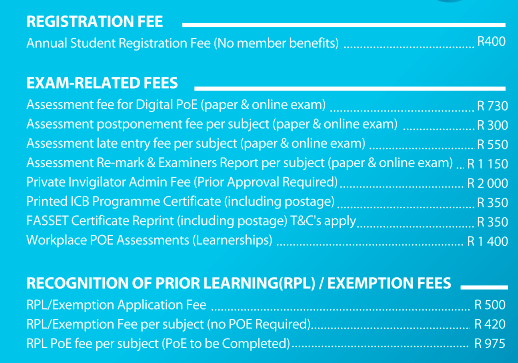
Here is a simple breakdown of the 2025 ICB course fees:

ICB Course feesCost
Annual Student Registration FeeR 500
Assessment fee for Digital PoE (paper & online exam)R 915
Assessment postponement fee per subjectR 375
Assessment late entry fee per subjectR 585
Assessment Re-mark & Examiners Report per subjectR 1 350
Private Invigilator Admin Fee (prior approval required)R 2 200
Workplace PoE Assessments (Learnerships)R 1 800
RPL/Exemption Application FeeR 600
RPL/Exemption Fee per subject (no PoE required)R 475
RPL PoE fee per subject (PoE to be completed)R 1 050
ICB Programme Certificate reprint (domestic)R 440
FASSET Certificate reprint (domestic)R 440
ICB Programme Certificate reprint (international)R 660
FASSET Certificate reprint (international)R 660
Certificate resend fee – domesticR 220
Certificate resend fee – internationalR 580
IQB SLP Certificate Prints (1–4)R 490
IQB SLP Certificate Prints (5–8)R 750
IQB SLP Certificate Prints (9–12)R 925
Results Transcript (Print & Send)R 180

These are the main costs you can expect when you sign up for an ICB programme, including bridging courses. The total you pay will depend on how many subjects you take and the extra services you need.

It’s best to check the latest prices with a course advisor before you register. You can also ask about affordable payment plans to make studying easier. With the right plan, you can spread the cost and focus on your learning without worrying too much about money.


The ICB Student Portal is an online platform for students who are studying an ICB Course. You can use this platform for various student activities including

  • Registering as an ICB student
  • Registering for the ICB Exam (This is NOT completed by Matric College)
  • Receiving a digital copy of your exam admission letter
  • Updating personal details
  • Paying ICB fees
  • Keeping up to date with the progress of your course
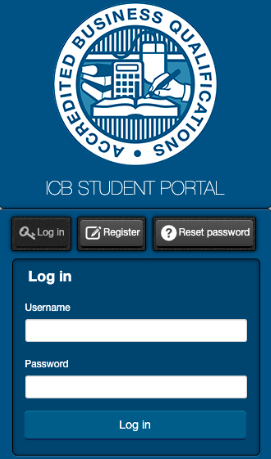
ICB Student Portal

ICB MACCI is a platform created by ICB for students to complete their assessments. This platform allows you to complete and submit assignments and to write online tests. You will also use this platform to complete your Portfolio of Evidence.
MACCI Digital Portfolio

  • You will receive login details for MACCI after you have entered a digital PoE Exam
  • Click on Courses to start your digital PoE
  • Complete your course step by step, the platform will guide you along the way
  • All the declarations are completed online while completing the PoE
  • You must complete each study step as shown on MACCI
  • You can complete a section at a time and come back at another time to complete the next section.
  • You can track the progress of your studies with the progress bar
  • You will know you are finished with your PoE if the progress bar is at 100%
It is important to take note of the due dates for the Portfolio of Evidence. They have to be done and submitted on ICB MACCI before you write your exam in-person or online. The due date is usually a week before the scheduled exam and if not submitted you will not be allowed to write the exams.

The ICB exams are written every second month so as you complete a subject you can write the exam. There are exam venues across South Africa. An option that is becoming more popular is being able to write the exam online from the comfort of your home. 

Here is the exam 2025 timetable for the ICB exam. You can download the timetable to plan your studies accordingly.

As mentioned above, you can use the ICB Student Portal to register for your exams. Here is how you can: 

  1. Register as an ICB Student by submitting the Student Details Form (this process is already done when you register for a course)
  2. Complete the Exam entry form using the dates available in the timetable. 
  3. You can choose whether to write your exam in person or online. If you choose to write in person you will need to select an exam venue as listed on the Student Portal. 
  4. ICB will issue you an admission letter you can use to write your exam. 

In-Person ICB Exam

In-Person ICB exams are written at designated exam venues and are run by ICB and their invigilators. Exam venues can include college facilities that are approved by ICB. To be admitted to the exam venue, you need to present proof of identification which can include: 

  • A green-barcoded ID book
  • An official ID card
  • A passport
  • A certified temporary ID document

In-Person exams are scheduled for morning sessions between 09:00 and 12:30 (three and a half hours). The first half-hour is for reading time and to explain the exam venue rules. If you arrive after the first half-hour, when the exam commences, you will not be allowed to enter the exam venue to write your exam. 

Distance learning students have two opportunities to write the exam in person. 

Smaller ICB exam venues have been discontinued due to the introduction of online exams. A lot of learners prefer writing online. 

Online ICB Exam

The online ICB exam follows the same procedure and duration but is scheduled for the afternoon session between 13:00 and 16:30. You have to log in before the start of the allocated time. If you attempt to log in thirty minutes after the scheduled time (when the exam commences) you will be considered late and will not be able to log in and write the exam. 

Just as in-person exams are invigilated, so are online exams. ICB has an online system that uses webcams on the students’ computers. This system uses facial recognition and tracks eye movement and computer activity outside of the exam webpage. 

There is an online exam survey students are required to complete post-exam. 

Distance learning students have six opportunities to write their exams online.

Are ICB Courses Recognised Qualifications?

Yes, ICB qualifications are recognised locally and internationally. Local recognition includes the 

  • NQF
    • All ICB Courses are recognised by the National Qualifications Framework
  • SAQA
    • The South African Qualifications Authority registers all ICB Courses and they are issued with SAQA ID numbers detailing the credits you earn and the learning outcomes
  • QCTO
    • The Quality Councils of Trade and Occupations offers guidance to skills development providers private and public. ICB Courses are Scarce Skills Qualifications and they must be accredited by the QCTO to implement occupational Qualifications.

There are many options you have once you have completed an ICB Course. You can continue studying with ICB to reach the next NQF level or you can begin your undergraduate studies at a university. You can also use your ICB Qualification to join a professional body. 

Study Further With ICB

ICB Courses progress from National Certificates (NQF 4) to National Diplomas (NQF 6). As you complete an ICB course at a specific NQF Level you can continue to study to achieve the next NQF level Certificate. 

If you have progressed and earned all the Certificates offered for one ICB Stream you can complete another ICB Stream and earn those Certificates too. 

Study Further Elsewhere

You can use your ICB Certificate/ Qualification to apply for undergraduate studies to achieve a degree. This all depends on the university and the Recognition of Prior Learning Policies they have in place. 

Read up on them if this is an option you want to pursue or you can join a professional body that allows you to study further as a member. 

Join A Professional Body

ICB recommends two professional bodies that recognise ICB Qualifications. They are the Association of Chartered Certified Accountants (ACCA) and the Chartered Institute of Management Accountants (CIMA). You can become a member of these professional bodies and even study further with them.

All of our ICB Study Programmes

ICB Business Management

ICB Business Management

ICB Business Management

Read More
ICB Office Administration

ICB Office Administration

ICB Office Administration

Read More
Financial Accounting - Business Management: ICB National Diploma

ICB Finanacial Accounting

ICB Finanacial Accounting

Read More

People Also Ask

The pass mark for an ICB exam is 60%. This means you need to achieve at least 60% overall for the subject to pass. Your final mark is made up of:

  • Portfolio of Evidence (PoE): Assignments, tests, and activities done before the exam.

  • Final Exam: Written at an official ICB exam centre or online, depending on your study method.

Both components count toward your final mark, so it’s important to perform well throughout the course—not just in the exam.

Yes, ICB qualifications are recognised in the UK, but it’s important to note that the ICB in South Africa and the ICB in the UK are separate professional bodies.

Your South African ICB qualification is SAQA-registered and accredited locally, and while many UK employers and institutions accept it for work or further studies, recognition is not automatic. You may need to have your qualification evaluated by UK NARIC (now Ecctis) to confirm its equivalence in the UK system.

Some UK-based employers, especially in finance, bookkeeping, and business administration, value ICB credentials because of their practical focus and structured learning pathway.

The main difference between ACCA and ICB lies in their scope, recognition, and career focus:

  • ACCA (Association of Chartered Certified Accountants)

    • An international professional body based in the UK.

    • Globally recognised in over 180 countries.

    • Focuses on advanced accounting, auditing, and finance at a professional chartered accountant level.

    • Requires higher entry requirements (usually Matric with maths, plus additional qualifications for full membership).

    • Can lead to senior accounting roles, financial management positions, and global career opportunities.

  • ICB (Institute of Certified Bookkeepers)

    • A South African professional body offering SAQA-registered, QCTO-accredited qualifications from NQF Level 3 to Level 6.

    • Recognised mainly in South Africa, with some international acceptance.

    • Focuses on bookkeeping, financial accounting, business management, and office administration.

    • Accessible without Matric (you can start with Grade 10 and progress to a National Diploma).

    • Geared toward practical, job-ready skills and entry-to-mid-level finance roles.

ICB Financial Accounting is a course that teaches you how to handle money for a business. You will learn how to keep financial records, do tax, plan budgets, and prepare reports like financial statements. These skills can help you get jobs like accountant, bookkeeper, or financial manager.

Yes, ICB is a recognised qualification in South Africa. It is approved by the Quality Council for Trades and Occupations (QCTO) and respected by employers. This means that completing an ICB course can help you get a job or move up in your career.

An ICB bridging course helps students who do not meet the usual entry requirements for an ICB programme. It gives you the skills and knowledge you need to start your chosen course. This makes it easier for you to continue studying towards your full qualification.

A: Not always. The ICB offers different qualification levels, including National Certificates (NQF 3–4), Higher Certificates (NQF 5), and National Diplomas (NQF 6). Whether you receive a certificate or a diploma depends on the course and level you complete. For example, Small Business Financial Management earns you a National Certificate, while Financial Accounting can take you all the way to a National Diploma.

ICB stands for the Institute of Certified Bookkeepers. It is a professional body in South Africa that designs and examines accredited business, accounting, and office administration qualifications. These courses are offered through ICB-accredited colleges like Matric College, giving you trusted, recognised skills that employers value.Not always. The ICB offers different qualification levels, including National Certificates (NQF 3–4), Higher Certificates (NQF 5), and National Diplomas (NQF 6). Whether you receive a certificate or a diploma depends on the course and level you complete. For example, Small Business Financial Management earns you a National Certificate, while Financial Accounting can take you all the way to a National Diploma.

Author: Mohamed S. Ajmoodien
Editor: Amy Venter
Date Published: March 30, 2022

Download a brochure

"*" indicates required fields

This field is for validation purposes and should be left unchanged.