

Your Matric Points for university entrance should be at least 23 Points (This is a Bachelor’s Degree Pass) or at least 19 Points (This is a Diploma Pass). If you apply with a Bachelor’s Degree Pass at university, you can apply for:
- Degree Courses
- Diploma Courses
- Higher Certificate Courses
- Certificate Course
- Short Courses
If you apply with a Diploma Pass at university, you can apply for:
- Diploma Courses
- Higher Certificate Courses
- Certificate Courses
- Short Courses

NOTE: Not all universities will accept your Diploma Pass. Therefore, it is important to research the university before applying as well as aim for higher marks. |
How Are University Matric Points Calculated?
University Matric Points are calculated by looking at your percentages for each subject completed in Matric and comparing them to your codes or (APS Scores). Here is a table with the codes (APS Scores) with the relevant percentages that match these APS scores:
Percentages (%) | Codes (APS Score) |
80 – 100 % | 7 |
70 – 79% | 6 |
60 – 69% | 5 |
50 – 59% | 4 |
40 – 49 % | 3 |
30 – 39% | 2 |
0 – 29% | 1 |
Below is another table with an example of how students marks look and their total APS Score:
Percentages (%) | Codes (APS Score) |
80 % – English Home Language | 7 |
89 % – Mathematical Literacy | 7 |
90 % – Life Orientation | 7 (This usually does not count for most courses at university) |
60 % – First Additional Language | 5 |
49 % – Business Studies | 3 |
30 % – Geography | 2 |
20 % – History | 1 |
This student’s total APS Score is 32 Points. | |
Which Marks Do Universities Look At?
Universities will look at the following marks:
- Grade 11 final marks
- Grade 12 June marks
- Grade 12 Statement of results
- Grade 12 Matric Certificate
Remember that each university is different, therefore you should always research the university before applying for a course. It is also important to always do your best and aim for high marks.
These are the subjects that universities generally look at:
- English Home Language
- Mathematics
- Mathematical Literacy
- Physical Sciences
- Life Sciences
Can I Apply With My Grade 12 June Results?
Yes, you can apply with your Grade 12 June results. Some universities will only look at your Grade 12 June results, whereas other universities will look at the above-mentioned results.
How Do You Get Accepted Into A University?
You can get accepted to university if you apply before the time. Universities are extremely strict about their registration dates, and therefore you should apply before the registration deadline. You need to achieve these three things before applying:
- Get a Bachelor’s Degree Pass
- Get an APS Score of 23 Points
- Choose subjects that are relevant to the course you are applying for
What Is A Distinction Pass In Matric?
A distinction pass in Matric is 80% or more. A distinction pass at university is 75% or more. Always try to aim for a distinction or distinction because this increases your chances of getting a Bachelor’s Pass and a higher APS Score. Universities are also impressed by distinctions because they can see the effort that you have put into your work.
What Is The Highest APS Score?
The highest APS Score is 49 Points. This is if you have received (7) seven APS Points for each subject. Below is a table with an example:
Percentages (%) | Codes (APS Score) |
80 % – English Home Language | 7 |
89 % – Mathematical Literacy | 7 |
90 % – Life Orientation | 7 (Some universities will not use this mark) |
96 % – First Additional Language | 7 |
99 % – Business Studies | 7 |
83 % – Life Sciences | 7 |
82 % – Economics | 7 |
This student’s total APS Score is 49 Points. | |
What Is The Lowest APS Score?
The lowest APS Score is 7 (seven) points. This is if you have received (1) APS Point for each subject. Below is a table with an example:
Percentages (%) | Codes (APS Score) |
22 % – English Home Language | 1 |
29 % – Mathematical Literacy | 1 |
20 % – Life Orientation | 1 (Most universities will not look at this mark) |
26 % – First Additional Language | 1 |
24 % – Business Studies | 1 |
23 % – Geography | 1 |
27 % – History | 1 |
This student’s total APS Score is 7 Points. | |
Is 29 A Good APS Score?
Yes, 29 is a good APS Score. This is a Bachelor’s Degree Pass, which means you can apply to a university and study a Degree Course.
Keep in mind that certain universities would prefer a higher APS Score. Always research the university’s requirements before applying. This helps you to prepare for the final Matric exam.
Is 33 A Good APS Score?
Yes, 33 is a good APS Score. This is a Bachelor’s Degree Pass. You may also apply for a Degree Course with this APS Score. Yet again, each university requires you to have a certain APS Score, always research before applying.
NOTE: Always keep in mind that the university’s APS Score is different from the course that they offer. This means that there are two (2) different APS Scores. For example, the university’s APS Score might be 33 points, but the APS Score for the course may be 35. This means that you should have an APS Score of 35 and higher. |
What Can I Study With APS Of 19?
You can study the following courses with an APS Score of 19:
- Diploma Courses
- Higher Certificate Courses
- Certificate Courses
- Short Courses
An APS Score of 19 is a Diploma Pass in Matric. If you would like to improve your marks, you can do so at Matric College. We offer a Matric Upgrade Course to students that need to improve their marks. Here is what you need to apply for the course:
- You must have proof that you have written the final Matric exam
- Failed Matric Certificate
- Incomplete Matric Certificate
- Passed Matric Certificate
- Statement of results
- Study through distance learning
- Understand, read and write English
Is Upgrading Matric A Good Idea?
Yes, upgrading your Matric is a good idea. Here is why you should complete a Matric Upgrade course:
- You can improve your marks and achieve a better Matric Pass Level. For example, you can go from a National Senior Certificate Pass to Bachelor’s Degree Pass.
- You can change your subjects to the ones required for university
- You can change your subjects to easier ones that will allow you to pass
What Is The Minimum APS Score For A Bachelor’s Degree In South Africa?
The minimum APS Score for a Bachelor’s Degree Pass is 23 Points. Here is what your marks will look like:
- 40% for your Home Language
- 50% for four other Higher Credit subjects
- 30% for two other subjects
The following subjects qualify as some of the High Credit Subjects | |
Languages | Non-languages |
How Many Subjects Do You Need To Pass Matric?
You need to pass (6) six out of your (7) seven subjects in Matric. This is if you are completing Matric in High School. If you are completing the Adult Matric Course, you only need to pass (5) five out of the (6) six subjects. Here is what you need to apply for the Adult Matric Course:
- You need to be 21 or older. Most students apply at 19, but they are 21 or older when they write the final exam.
- Apply with a Grade 9 Certificate or Equivalent Certificate (ABET Level 4)
- Understand, read and write Afrikaans or English
- Study through distance learning
Can You Go To University With An ABET Level 4?
No, you cannot go to university with an ABET Level 4. This qualification is at NQF Level 1, which is equivalent to a Grade 9 Certificate. If you want to go to a university, you have to complete your Matric and you need to pass with a Bachelor’s Degree Matric Pass Level.
How Matric Results Are Calculated?
Here is a table with how your Matric results are calculate
| Internal Assessments | Final Exam |
This counts 25% towards your final mark |
This counts towards 75% of your final mark |
How Do I Calculate My Matric Average Percentage?
You can calculate your Matric average percentage by adding all of your marks and dividing it by (7) seven. Here is how you can calculate your Matric average percentage:
Percentages (%) | Codes (APS Score) |
% – English Home Language | ? |
% – Mathematical Literacy | ? |
% – Life Orientation | ? |
% – First Additional Language | ? |
% – High Credit Subject 1 | ? |
% – High Credit Subject 2 | ? |
% – High Credit Subject 3 | ? |
% +% +% +% +%+%+% ➗ 7 = ? | |
Where Can I Study If I Failed Matric?
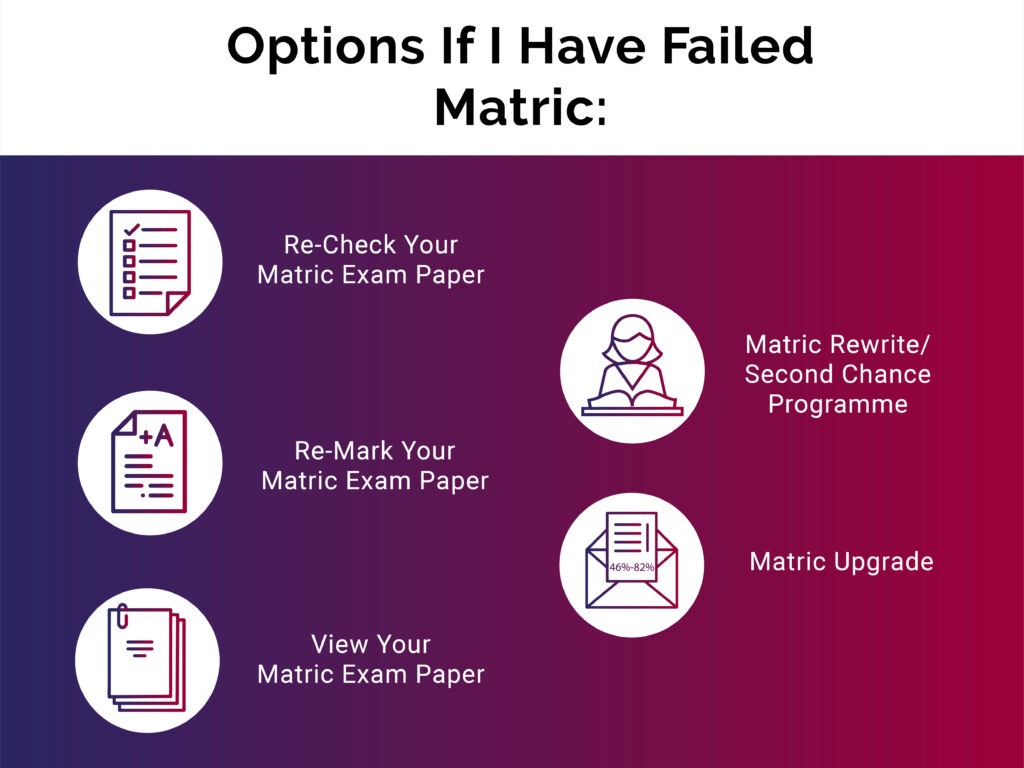
If you have failed Matric, you can study at Matric College. Here is what you can do if you want to get your Matric if you are younger than 21 and if you are older than 21:
Why Should I Complete Get My Matric At Matric College?
Here is why you should study at Matric College:
- You can improve your Matric marks
- You can get your Matric as an adult
- You can complete courses without Matric
- You can complete courses with any Matric Pass Level
Here are reasons why distance learning will benefit you:
- You can work and study
- You may register any time
- Your textbooks are sent to you through courier services
- You can set your own pace for studying
Get the perfect APS Score at Matric College!
Author: Jesmé Africa
Editor: Razeen Dollie
Date: June 13, 2022